
Exactly Who Is an AI Product Manager?
Using ChatGPT is not enough. Learn what AI Product Managers actually build, measure, and change across an organisation.
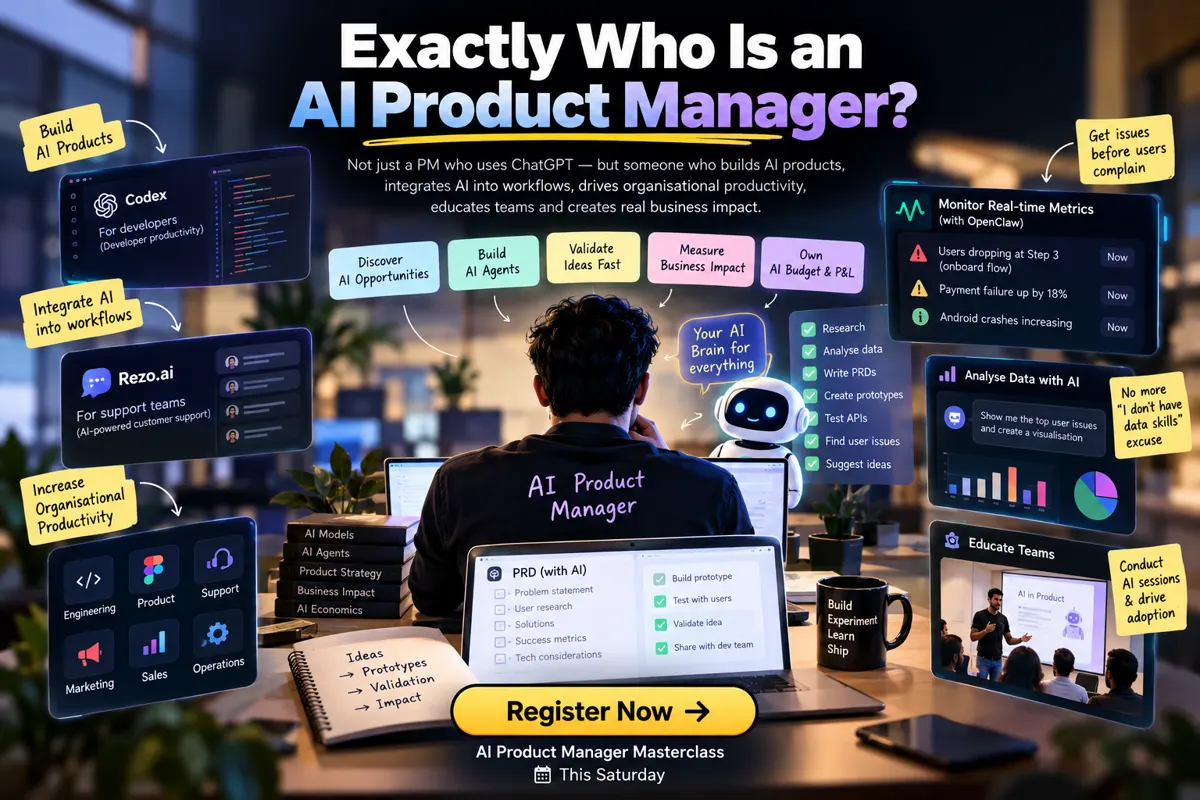
Want to become an AI Product Manager? Register Now for the AI Product Manager Masterclass →
Let me start with something controversial:
Using ChatGPT to write your PRD does not make you an AI Product Manager.
Automating your daily tasks with AI does not make you an AI Product Manager either.
In fact, if the biggest achievement you have with AI is that you automated your own work, you might just be a lazy PM who found a faster way to do the same work.
A real AI Product Manager does something much bigger.
Register Now → AI Product Manager Masterclass
They use AI to increase organisational productivity, integrate AI into existing workflows, introduce completely new AI-powered products, educate teams, build AI capabilities, measure their business impact, and eventually make AI a core part of how the organisation operates.
That is what an AI Product Manager actually looks like.
So, Who Exactly Is an AI Product Manager?
An AI Product Manager is someone who can answer:
"Where can AI create measurable business value for my organisation, and how do we actually build and deploy it?"
That could mean building a developer productivity tool like Codex.
It could mean introducing an AI-powered customer support system like Rezo.ai.
It could mean building internal AI agents for operations, sales, HR, finance, analytics, or engineering.
It could mean using AI to eliminate repetitive workflows.
It could mean creating an entirely new AI-native product.
Or it could simply mean teaching your organisation how to use AI effectively.
The common thread is simple:
You don't just use AI. You make the organisation better because of AI.
An AI PM Has to Educate the Organisation
One of the most underrated responsibilities of an AI Product Manager is AI education.
AI is moving too fast.
A technology that didn't exist six months ago can suddenly become extremely relevant to your business.
New models.
New agents.
New coding tools.
New multimodal capabilities.
New APIs.
New reasoning models.
New automation frameworks.
New AI infrastructure.
A good AI PM can't wait for someone else to explain these things.
You have to constantly learn—and then make your organisation learn.
That could mean:
- AI workshops
- Internal AI sessions
- Tool demonstrations
- AI newsletters
- Agent-building sessions
- Use-case discovery workshops
- AI adoption programs
- Internal documentation
- Experimentation programs
The AI PM becomes the person people ask:
"Hey, can AI solve this?"
And you should have an answer.
Your Job Is Not to Automate Yourself
This distinction is extremely important.
Imagine a PM says:
"I use ChatGPT to write meeting notes, create Jira tickets and draft PRDs."
That's useful.
But that's personal productivity.
Now imagine another PM says:
"I identified 14 repetitive workflows across customer support, operations and engineering. I built AI-powered solutions for 8 of them, measured adoption, reduced operational workload by 32%, and created a roadmap to scale the remaining use cases."
That's an AI Product Manager.
The difference is scope and business impact.
One person made themselves faster.
The other made the organisation faster.
AI PMs Need to Think About P&L
This is where AI Product Management becomes much more interesting.
AI isn't free.
Every model call has a cost.
Agents consume tokens.
Infrastructure costs money.
APIs cost money.
Data pipelines cost money.
Vector databases cost money.
Inference costs money.
And therefore, an AI PM needs to understand:
AI Budget → AI Investment → AI Usage → Business Impact → P&L
If you're proposing an AI product that costs ₹20 lakh annually, you should be able to explain:
- What are we spending?
- Why are we spending it?
- What business problem does it solve?
- How many users will use it?
- What is the cost per interaction?
- What is the expected ROI?
- How much revenue can it generate?
- How much operational cost can it reduce?
- What happens to the P&L if adoption doubles?
- What happens if the model cost increases?
That's product management.
But now with an AI economics layer.
The Traditional PM Workflow Is Changing
The old workflow often looked something like:
Idea → Research → Data Analysis → PRD → Design → Engineering → QA → Launch → Analytics
And sometimes the PM spent days writing a PRD before anyone even knew whether the idea was worth building.
AI changes this.
A modern AI PM can build an internal AI brain for the organisation.
Give it access to:
- Product documentation
- Previous PRDs
- Customer feedback
- Analytics
- Research
- Support tickets
- Business metrics
- Product specifications
- Technical documentation
Then instead of spending five days manually creating a PRD from scattered information, you can discuss the problem with your organisation's AI brain first.
Ask it:
"What happened to this metric?"
"What are the top complaints from users?"
"Have we built something similar before?"
"What edge cases did we face previously?"
"Which user segments are affected?"
"What data supports this problem?"
Then use that discussion to create a much better PRD.
AI doesn't replace product thinking.
It removes the unnecessary manual work around product thinking.
AI Agents Will Become Part of the PM Toolkit
Here's another major shift.
A modern PM shouldn't always wait for an engineer to validate every small technical assumption.
You can build lightweight AI agents yourself.
For example:
Agent 1 — API Testing Agent
Give it an API specification and ask it to test:
- Happy paths
- Invalid inputs
- Edge cases
- Authentication failures
- Missing parameters
- Unexpected responses
Agent 2 — Customer Feedback Agent
Feed it thousands of support conversations and ask:
"What are the top five problems users are facing?"
Agent 3 — Competitor Monitoring Agent
Let it continuously monitor competitor products, pricing, features and announcements.
Agent 4 — PRD Critic Agent
Give it your PRD and ask:
"What have I missed?"
Agent 5 — MVP Agent
Describe an idea and let AI help you build a working prototype before you take it to engineering.
Now your role changes.
You're no longer just writing specifications.
You're experimenting.
MVP Validation Is Becoming Faster
Previously, a PM might say:
"I have an idea, but I need engineering resources to validate it."
Not always anymore.
If you have an idea for a simple product or workflow, AI can help you build a prototype yourself.
You can:
Idea → Prototype → Test → Learn → Iterate
before asking a full engineering team to build the production version.
This doesn't mean PMs should replace engineers.
It means PMs can reduce the amount of uncertainty they bring to engineering.
Instead of saying:
"I think users will like this."
You can say:
"I built a prototype, tested it with 30 users, analysed the behaviour, and here's what we learned."
That's a much stronger product conversation.
"I Don't Have Data Skills" Is Becoming a Weak Excuse
This is another uncomfortable truth.
A PM saying:
"I can't analyse this because I don't know SQL."
is becoming less defensible.
I'm not saying every PM needs to become a data scientist.
But today you can connect AI tools such as ChatGPT or Claude to your datasets and ask them to:
- Analyse CSVs
- Write SQL
- Explain SQL
- Find patterns
- Segment users
- Identify anomalies
- Build visualisations
- Analyse funnels
- Compare cohorts
- Generate hypotheses
You still need to understand what the data means.
That's the important part.
AI can help you perform the analysis.
You still own the product decision.
And Then Comes the Most Interesting Part: Always-On Product Intelligence
Imagine your product has an AI agent that is continuously observing what is happening.
Not tomorrow.
Not after your weekly Mixpanel review.
Now.
Imagine the agent notices:
"Users are repeatedly dropping at Step 3 of onboarding."
Before you open your analytics dashboard, you already know.
Imagine it notices:
"Payment failure increased by 18% in the last two hours."
You get an alert.
Imagine:
"Users from Android version X are experiencing a significant increase in crashes."
You know immediately.
This is where tools like OpenClaw and always-on AI agents become interesting.
The product can have an intelligent layer that continuously observes behaviour and surfaces problems.
The traditional model was:
User → Product → Data → Dashboard → PM → Decision
The emerging model is:
User → Product → AI Agent → Insight → PM → Decision
That's a massive shift.
So What Does an AI Product Manager Actually Do?
A strong AI PM might be doing all of this:
1. Discover AI opportunities
Find where AI can create value inside the organisation.
2. Build AI products
Create products where AI is actually part of the core experience.
3. Integrate AI into existing products
Identify where AI can improve an existing workflow.
4. Build AI agents
Create internal agents that automate research, operations, analysis and testing.
5. Increase organisational productivity
Make teams—not just yourself—more productive.
6. Educate the organisation
Run AI sessions and help teams understand new technologies.
7. Stay updated
Constantly track new models, tools, agents, APIs and AI capabilities.
8. Measure AI impact
Track adoption, quality, cost, latency, retention, revenue and productivity.
9. Own AI economics
Understand model costs, infrastructure costs, budgets, ROI and P&L impact.
10. Validate ideas faster
Use AI to build prototypes and test assumptions before investing heavily in engineering.
11. Continue doing Product Management
And yes—you still need to do everything a good PM traditionally does:
Problem discovery.
User research.
Prioritisation.
Roadmapping.
Strategy.
Metrics.
Stakeholder management.
Product execution.
AI doesn't remove Product Management.
It raises the bar for Product Managers.
Look at What Modern AI PMs Are Doing
If you want to understand what an AI Product Manager actually looks like, don't just read job descriptions.
Look at the people doing the work.
Check out profiles like:
Abhijay Vuyyuru
https://www.linkedin.com/in/abhijayvuyyuru
Shubham Saboo
https://www.linkedin.com/in/shubhamsaboo
And then look beyond their LinkedIn posts.
Look at their GitHub.
Look at what they're building.
Look at how frequently they're experimenting.
Look at the agents they're creating.
Look at how quickly they're adopting new AI technologies.
That's the mindset shift.
The best AI PMs aren't sitting around waiting for AI to become mainstream.
They're already experimenting with what comes next.
The AI PM Skillset Is Expanding
The traditional PM skillset looked something like:
Product Sense + Strategy + Execution + Analytics + Communication
The AI PM skillset increasingly looks like:
Product Sense + Strategy + Execution + Analytics + AI Literacy + Experimentation + Technical Fluency + AI Economics + Agentic Workflows
You don't necessarily need to become an ML engineer.
But you should understand enough to ask the right questions.
You should know what an API is.
You should understand models.
You should understand context windows.
You should understand embeddings at a basic level.
You should understand RAG.
You should understand agents.
You should understand evaluation.
You should understand hallucinations.
You should understand inference cost.
You should understand AI safety and reliability.
And most importantly:
You should know when AI is actually useful—and when it isn't.
The Real Definition
So, let's finally answer the question.
Who is an AI Product Manager?
An AI Product Manager is not a Product Manager who uses ChatGPT.
An AI Product Manager is someone who understands AI deeply enough to identify opportunities, builds AI-powered products and workflows, increases organisational productivity, educates teams, experiments with emerging technologies, owns AI economics, measures business impact, and continues to apply strong product thinking to an increasingly AI-native organisation.
And there's one more important distinction:
A good AI PM doesn't just ask, "How can I use AI?"
They ask:
"What could our organisation become if AI was built into everything we do?"
That's the real question.
Want to Become an AI Product Manager?
If you want to learn how to actually become an AI Product Manager—not just learn a few AI tools—we're conducting an AI Product Manager Masterclass this Saturday.
We'll cover:
- What an AI PM actually does
- How to identify AI opportunities
- AI agents for Product Managers
- Building AI-powered workflows
- AI product experimentation
- AI PM technical skills
- AI metrics and evaluation
- AI economics
- Building your own AI PM toolkit
- How to become more effective as a PM using AI
🚀 Register Now
Register Now for the AI Product Manager Masterclass →
If you're serious about becoming an AI Product Manager, don't just learn how to use AI. Learn how to build with it, think with it, and transform products with it.
The future doesn't need PMs who merely use AI.
It needs PMs who know what to build with it.
Ready to land your next PM role?
Browse 2,500+ verified product manager jobs updated daily.
Browse PM Jobs